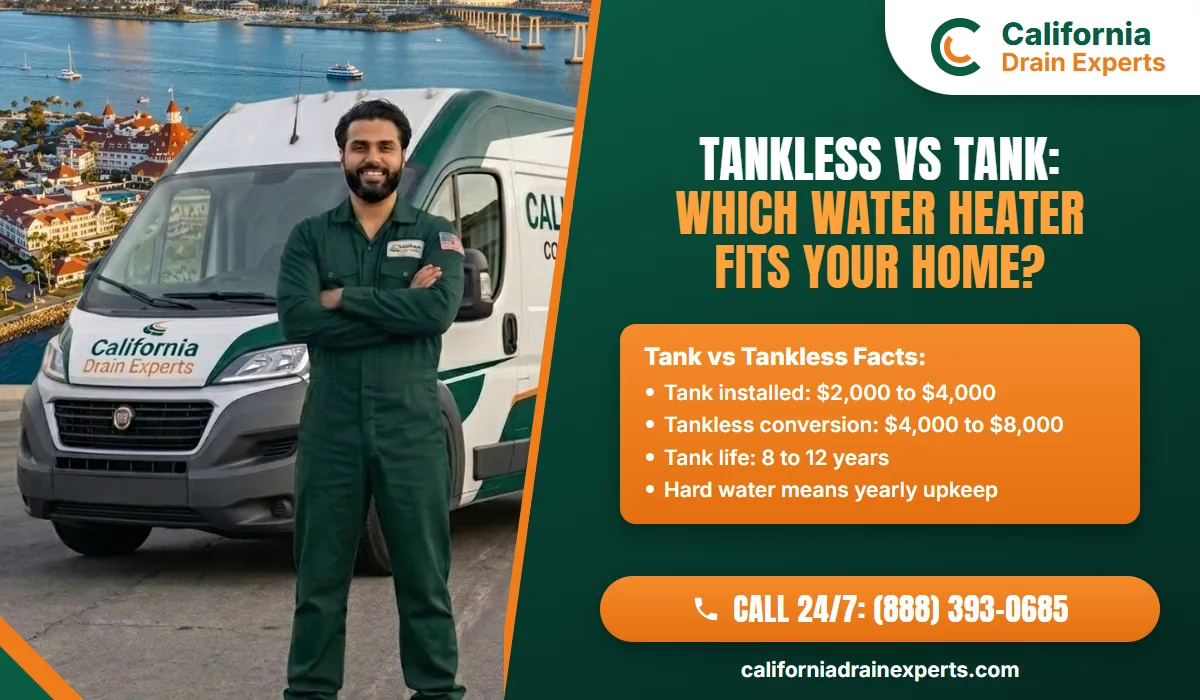
For most California households, a tank water heater is the lower upfront cost and a tankless unit is the better long-term fit if you run out of hot water or need the floor space. The deciding factors here are gas line size, hard water and household size.
Side by Side
| Tank | Tankless | |
|---|---|---|
| Installed cost | $2,000 to $4,000 | $4,000 to $8,000 conversion |
| Hot water supply | Limited to tank size | Continuous |
| Typical lifespan | 8 to 12 years | 15+ years with descaling |
| Hard water care | Yearly flush | Yearly descale |
| Space | Floor footprint | Wall mounted |
The Gas Line Question
Tankless units need far more gas at full demand than a tank. Many California homes need a larger gas line for a conversion, which can add $500 to $2,000.
Thinking about going tankless?
A site check tells you whether your gas line, venting and water quality are ready.
Call (888) 393-0685Hard Water Changes the Math
Much of Southern California has hard water. Tankless heat exchangers scale up without yearly descaling, and tanks fill with sediment without yearly flushing. A water softener reduces both.
Who Should Choose Which
- Tank: smaller households, tight budgets, homes where a gas line upgrade would be costly.
- Tankless: larger families, homes that run out of hot water, garages and closets where space matters.
See tankless water heater installation and water heater replacement for details.
Operating Costs
Tankless water heaters only heat water when you use it, so they avoid the standby heat loss of a tank that keeps 40 or 50 gallons hot all day. The savings depend on how much hot water your household uses. Small households save the most per gallon, while larger families mostly benefit from never running out.
Air Quality Rules in Southern California
In the South Coast air district, which covers Orange County and much of Los Angeles, Riverside and San Bernardino counties, new gas water heaters must meet low-NOx emission limits. Both tank and tankless units are made to meet these rules, but it is one more reason to have a professional choose and install the unit.
Hot Water Delivery
A tank stores hot water, so the first draw is hot as soon as the pipes are. A tankless unit needs a moment to fire and heat, so you may notice a short delay at distant fixtures. Running several showers at once requires a unit sized for that flow. Undersized tankless units are the most common source of complaints.
Installation Requirements
- A gas line large enough for full-demand operation
- Venting that matches the unit, often a new route through a wall or roof
- A condensate drain for condensing models
- An electrical outlet for the controls
- Service valves for annual descaling
If several of these are missing, a conversion costs more. A site check shows what your home already has.
Maintenance Compared
| Task | Tank | Tankless |
|---|---|---|
| Annual service | Flush sediment | Descale heat exchanger |
| Typical service cost | $150 to $300 | $200 to $400 |
| Main failure point | Tank corrosion | Scale and sensors |
For tank owners, see water heater flush. For tankless owners with error codes, see tankless water heater repair.
The Short Answer
If you are replacing a failed tank and your household rarely runs out of hot water, another tank is usually the simplest and cheapest choice. If you are tired of cold showers, need the garage space, or are planning to stay in the home for many years, tankless is worth pricing out.
Space and Placement
A tank takes up a footprint of roughly two feet by two feet plus clearance, often in a garage, closet or service porch. A tankless unit mounts on a wall and can often go outside on an exterior wall in Southern California’s mild climate, freeing up indoor space entirely. For garage conversions and ADUs, that difference can decide the choice.
Lifespan and Replacement Timing
Tanks in hard water areas commonly last 8 to 12 years, and failure often means a leak. Tankless units commonly last longer with annual descaling, and their parts can usually be replaced individually. Over 20 years, a household might replace a tank twice in the time one tankless unit lasts.
Questions to Ask Before Converting
- Is my gas meter and gas line large enough?
- Where will the unit vent, and does it need a new route?
- How hard is my water, and should I add a softener?
- How many fixtures do we run at the same time?
- What does annual descaling cost?
Getting these answered before you choose saves the most common tankless regrets.
Need help today?
Call California Drain Experts. The price is confirmed before any work starts.
Call (888) 393-0685Frequently Asked Questions
Is tankless worth it in California?
It can be for households that run out of hot water or want to save space, as long as the gas line and descaling are planned for.
Do tankless water heaters need maintenance?
Yes. In hard water areas they need descaling about once a year.
Will I need a bigger gas line?
Often yes for a conversion.
Which lasts longer?
Tankless units often last longer with regular descaling.
Local Help
For a tank or tankless install near you, see water heater repair in Los Angeles, water heater repair in San Diego, water heater repair in Orange County, water heater repair in Torrance, water heater repair in Huntington Beach and water heater repair in Long Beach. Every page has the same 24/7 number, (888) 393-0685.